
 Seretary of Mexico's Public Safety Department
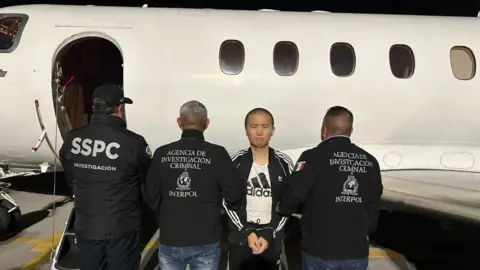
Through a evening announcement on Thursday, the Cuban Government declared that it had extradited a Chinese citizen, Zhang Zhi Dong, to Mexican officials. Hours later, Mexico's security chief then confirmed his later transfer to US custody on drug trafficking and money laundering charges.
This concluded a months-long, daring flight effort by one of the world's most wanted fugitives.
Known by various aliases such as Brother Wang, Pancho, or HeHe, Zhi Dong Zhang faces charges from US prosecutors for orchestrating a vast international ring of fentanyl trafficking and money laundering spanning multiple countries with key operations in China, Mexico, and the United States.
The list of charges against Mr Zhang is long but in essence American and Mexican legal authorities allege his significant role within international narcotics trafficking. Authorities claim he processed vast sums in drug money on behalf of the Sinaloa and Jalisco cartels as part of a worldwide drug distribution network.
"This individual can be seen as an essential connection linking Mexican drug syndicates with chemical firms in China in sourcing the pre-cursor chemicals for fentanyl", explains former DEA agent, a retired agent, adding that he was also vital in converting drug funds into cryptocurrency.
Upon being found guilty, Zhang Zhi Dong can expect to share a similar fate as other drug kingpins like Joaquin 'El Chapo' Guzman and Ismael 'El Mayo' Zambada within a maximum-security prison in the United States.
However, his detention in Havana is an extraordinary tale featuring an escape from home confinement in Mexico City, reportedly through a hole in a wall, boarding a private aircraft to Cuba and an ultimately failed attempt to gain entry into Russia.
Zhang's initial arrest occurred in Mexico City in a joint security operation in October 2024. He was initially held in a maximum-security prison but subsequently received home confinement by a judge – a decision that President Claudia Sheinbaum called "outrageous".
His breakout had all the hallmarks of yet another humiliating incident for Mexican authorities: an individual deemed crucial in the machinery of drug smuggling, managing to vanish despite Mexican official surveillance tasked with guarding him. El Chapo Guzman managed that feat twice, much to Washington's frustration, before he was finally put on a plane in handcuffs to the US.
The recapture of the fugitive and send him north came down to two things – an apparent stroke of luck in Russia and robust Mexico-Cuba security ties.
Upon arriving in Cuba during July 2025, he set about making his next steps towards reaching a country with no extradition treaty with the US, officials say.
A direct commercial air route exists to Moscow from Havana and Zhang, authorities claim, was able to secure a seat on it with fraudulent documents. However, the papers didn't get him past the immigration authorities in Russia. Reports indicate Russian authorities didn't fully recognize the identity of their detainee and, after he was briefly detained, they turned Zhang around and sent him back to Cuba.
Following his second Havana arrival, the Cuban security services were now aware regarding his true identification.
Security analysts believe the authorities in Cuba held onto him over multiple months to interrogate him at length prior to his Mexico repatriation and, inevitably, onwards to the US. Mexico's security secretary, Omar Harfuch, was quick to thank Cuba for their collaboration regarding 'Brother Wang' – essentially, preventing further embarrassment concerning another fleeing notable inmate.
As always following the arrest of an alleged kingpin, the question becomes how far their removal will affect international narcotics trafficking.
Given Brother Wang has spent the past year either in prison, under house arrest or on the run, this inquiry might be irrelevant, Mr Vigil said, as his absence has already largely been felt within Mexico's illicit circles:
"It's really not going to have an impact as the cartels already have individuals working for them capable of substituting Brother Wang", says Mr Vigil. "Even with El Chapo Guzman a more prominent figure, global narcotics flow continued unabated", he contends.
During his initial presidential year, US President Donald Trump has urged Mexico's leader to intensify fentanyl trafficking efforts and the Sheinbaum government has correspondingly acted. She has significantly increased seizures of the drug compared to her predecessor and has extradited numerous of convicted drug cartel members to the United States for sentencing. These included major narcotics figures such as Rafael Caro Quintero, wanted for the murder of a DEA agent in 1985.
Collaboration on fentanyl matters, as well as on undocumented immigration, is considered the reason Mr Trump has refrained from imposing the same level of trade tariffs on Mexico as he has on other commercial partners.
Zhang's transfer will provide real gratification in Washington for removing a crucial individual in Mexican cartels' financial operations out of circulation. This, subsequently, will satisfy Mexico's Sheinbaum government and strengthen their claim of close security alignment with US partners.
Nonetheless, curbing or diminishing the flow of precursor substances from China to the Americas for fentanyl in any lasting way will take more than the extradition of one man.


